





Details courtesy of Wikipedia:
CCGS Cape Roger
From Wikipedia, the free encyclopedia

Mayflowers and Unidentified Spores and LichensThe Mayflowers are beginning to bloom out our way despite the cold relentless winds of the North Atlantic. They are about 5% open with the balance in bud. I expect complete displays within a week, with some 100+ flower clusters. We had our first Coltsfoot blooming on March 9, 2016 but they soon withdrew under late winter snow. Among the Mayflower displays there are blooming moss spawn and lichen, all of which remain unidentified so far. Ruby-throated Hummingbirds were reported in Nova Scotia yesterday so put your feeders up. Mayflower
Lichens
Moss Spawn
Overwintering and Migrant Birds at Portuguese CoveThis is a compendium of some of our over-wintering and early migrating birds from the last week at Portuguese Cove. It's been an interesting winter overall with White-winged Dove, Yellow-breasted Chat, Grey Catbird and White-winged Crossbill paying us extended visits. Brown-headed Cowbird
Common Grackle
Dark-eyed Junco
Purple Finch
Savannah Sparrow
Song Sparrow
White-winged Crossbill
Downy Woodpecker
Mourning Dove
Northern(yellow-shafted) Flicker
Pine Siskin(My Spirit Animal)
White-throated Sparrow
Louisiana Waterthrush and FriendsI found and photographed the Louisiana Waterthrush yesterday at the third cobbly beach, Crystal Crescent Provincial Park. This beach has always been productive for overwintering birds such as Pipits, Lapland Longspur, Snow Buntings and Song Sparrows. The rotting seaweed fosters the growth of maggots and kelp flies. My photographs of the Louisiana Waterthrush are distant and cropped. This bird is extremely rare, indeed it is the first one I've encountered in Nova Scotia in 16 years, although I have seen them previously in Southern Ontario. Louisiana Waterthrush
The beach is highly utilized by overwintering Pipits, sometimes in company with the Louisiana Waterthrush. American Pipit
Migrating American Robins congregate here as well, although I've never seen one overwinter. American Robin
American Pipit
Ipswich Sparrow
Meanwhile back home at Portuguese Cove the White-winged Crossbill still visits daily. White-winged Crossbill
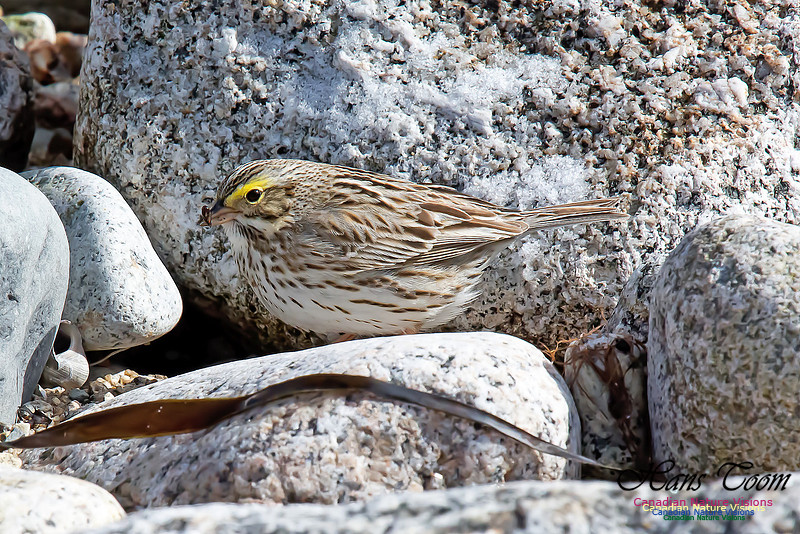
Ipswich SparrowOther priorities prevented me from arriving at Crystal Crescent Beach early this morning to find and photograph the Louisiana Waterthrush. When the birders left I lingered underdressed for the bitter cold and wind hoping for a revisit. There were lots of Iceland Gulls and Pipits milling about. Pipits often overwinter at these kelp heaps sometimes accompanied by Snow Buntings and Lapland Longspurs. The consolation prize was my first Ipswich Sparrow of the spring. This variant of the Savannah Sparrow is a larger, lighter and tougher bird thought by some experts to be a separate species. They breed primarily on Sable Island after assembling along the coast to fuel up for the long and treacherous oversea crossing. Their lighter colour may be an adaption of camouflage due to nesting on and about the sandy dunes of Sable Island. Ipswich Sparrow
The Song Sparrow is in full song now all along our coast. Song Sparrow
White-winged Crossbill, Goldfinch and Tree SparrowThe White-winged Crossbill continues to be a daily regular at our place in Portuguese Cove(up to and including April 4) feeding at the sunflower seed tray several times per day. The over-wintering Goldfinches are beginning to yellow up even while the bright yellow Goldfinches return from their wintering grounds from down south. Tree Sparrows will start leaving soon but not just yet as they fatten up for the journey north. Goldfinch
Tree Sparrow
White-winged Crossbill
White-winged Crossbill Continues to VisitThe White-winged Crossbill continues to be a regular at our feeder in Portuguese Cove. All photos except two are taken through the kitchen window while the crossbill feeds at our window feeder. He is definitely the boss bird of the tray opening his rapier like bills to deter any interlopers. White-winged Crossbill These first two photos were taken outside.
These other photos were taken through the kitchen window.
Ring-necked DucksLaura and I enjoyed a walk-around of the Frog Pond, Sir Sanford Fleming Park, yesterday. Sanford, the Wood Duck, was nowhere to be found but we did run across two adult male Ring-necked Ducks. The ring around the neck is obvious, albeit an inferior field mark to the ring on the bill. These photographs are severe crops about equivalent to the sensor area of a point and shoot camera. Yesterday's White-winged Crossbill was still here today. Perhaps I can improve upon my photos and actually photograph one outside. Ring-necked Ducks
White-winged CrossbillA first winter male White-winged Crossbill paid us a quick visit today. It came in with a bunch of Bohemian Waxwings that refused to stay to be photographed. As usual I had to photograph my birds through two layers of glass. White-winged Crossbill
There was also a bunch of male Purple Finches, probably still overwintering birds. Purple Finch
Fox Sparrow and Tree SparrowI photographed two of my favourite sparrows yesterday, both through two layers of window glass. Any attempt at opening a window results in my clients scattering. The first sparrow I photographed was the Tree Sparrow. It is almost exclusively a Canadian breeding bird, although many migrate further south to overwinter. The name Tree Sparrow is no way descriptive of this species. We usually have about 20 overwintering at our place in Portuguese Cove. Tree Sparrow
The first returning migrant sparrow is usually the Fox Sparrow, a handsome bird, with a melodic song that echoes through the deep woods. Some overwinter in Nova Scotia. One year we enjoyed one here at Portuguese Cove for 15 continuous months. They breed in nearby Crystal Crescent Beach Provincial Park. Fox Sparrow
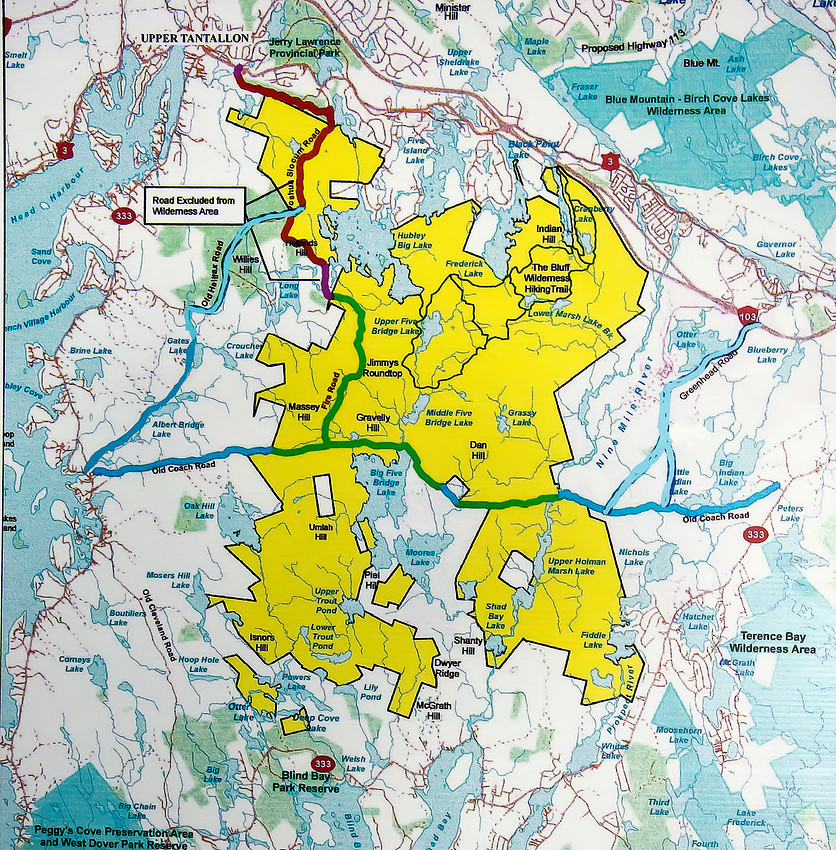
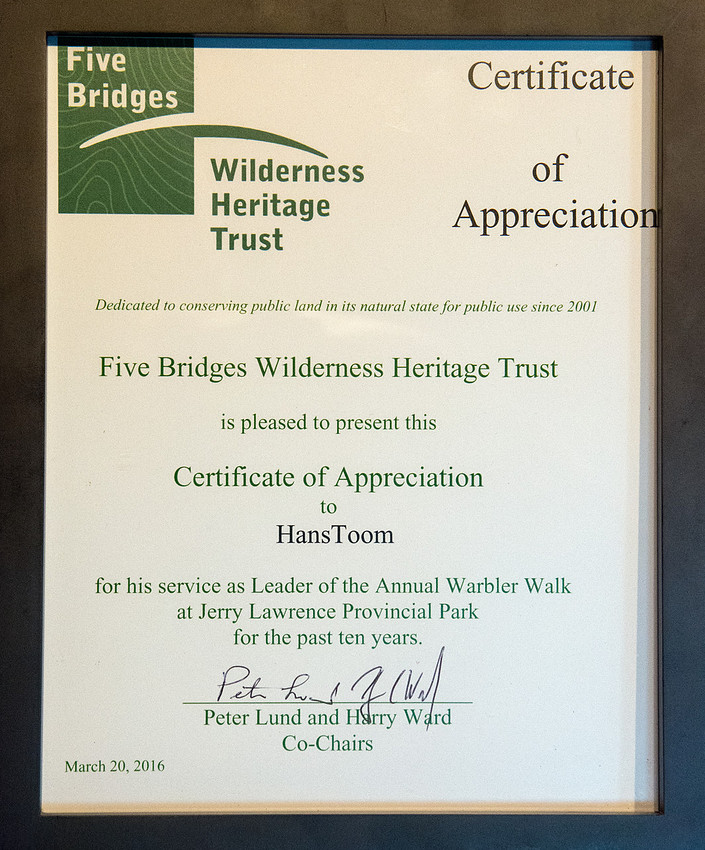
Five Bridges Wilderness Heritage Trust Annual General Meeting March 20, 2016Laura and I attended the Five Bridges Wilderness Heritage Trust Annual General Meeting March 20, 2016. Highlights were audio visual shows of the Bluff Wilderness Trail and updates on the great work undertaken by the trust and its allies. Beth McGee was honoured again for her great work over the last 14 years culminating in the creation of the Five Bridges Lakes Wilderness Area.
The map below outlines the Wilderness Area with some of the works to be undertaken in future months and years.
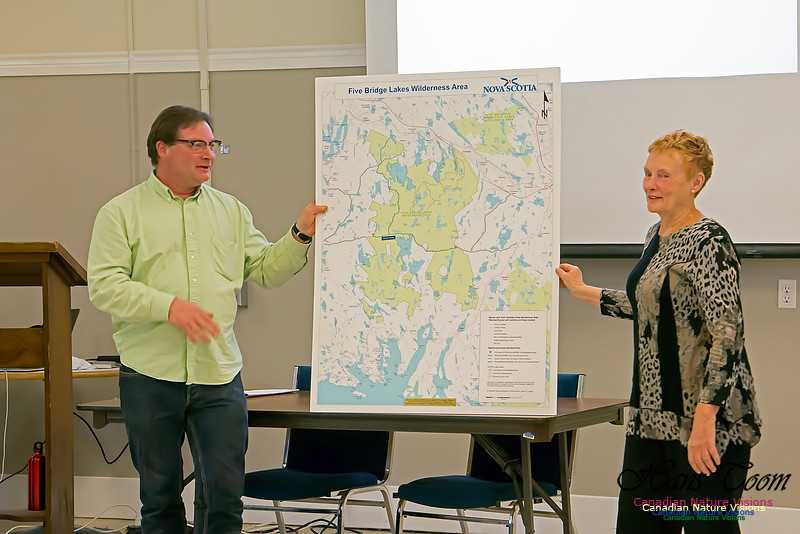
Harry Ward(co-chair) and Beth McGee(treasurer) showing the plaque(map) given to Beth of the Five Bridges Lakes Wilderness Area.
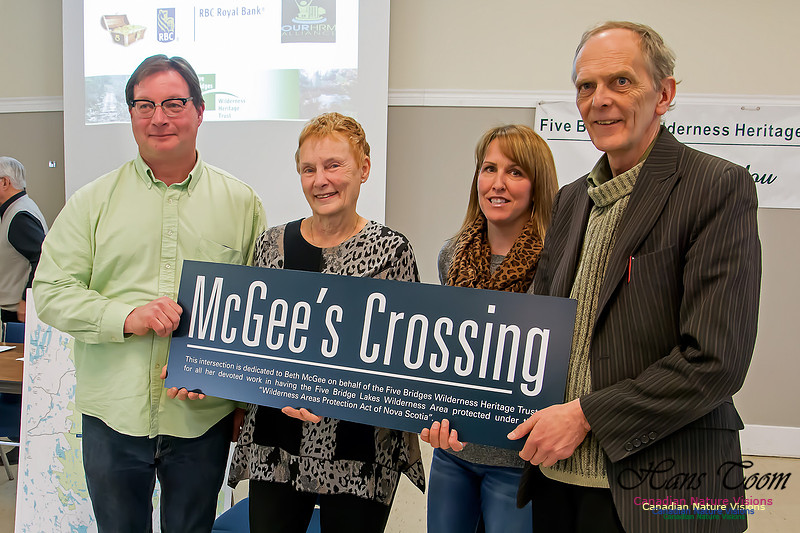
Beth was also honoured with trail signage in her name:
Yours truly was not forgotten.
CCGS Cape RogerThe CCGS Cape Roger is a new coast guard ship for me. It sailed past our place this morning. It is primarily a search and rescue vessel homeported at St. John's Newfoundland and Labrador.
Details courtesy of Wikipedia:
CCGS Cape RogerFrom Wikipedia, the free encyclopedia
CCGS Cape Roger is an Offshore Patrol Vessel operated by the Canadian Coast Guard.[1] The vessel was built at Ferguson Industries Ltd., Pictou and commissioned into the CCG in 1977. She underwent a modernization at Shelburne Marine, Shelburne in 1996. CCGS Cape Roger is homeported at CCG Base St. John's in St. John's, Newfoundland and Labrador. In 2010 the Cape Roger underwent another refit at the SMI drydocks on the Welland Canal, located in St Catharines Ontario. Winter's Last GaspYesterday was our winter's last gasp, surely. I took an hour to photograph some of the local scenery. Usually our snow storms are of the soft and fluffy variety that do not cling to the branches. Yesterday's snow fall was soft, wet and sticky, ideal for photographs.
Winter's Icy GripI went up to Butcher's Falls on March 4 to see what the recent cold weather had accomplished. I call this, "Winter's Icy Grip". Perhaps this is its last gasp. I hope! Winter's Icy Grip
Conjunction of Jupiter and our MoonAfter our visit to Peggy`s Cove yesterday to photograph the sunset I was just minding my own business loitering in the living room when Laura pointed out a bright planet beside our moon. I was not prepared for this phenomenon but when I put my binoculars on it, 18X50 IS, I spotted four moons around the planet, so our bright planet had to be Jupiter. Photographing these guys is a challenge since Jupiter and its moons requires a lot more light than the moon. I took my exposure readings about half way between Jupiter and the Moon so the moon is consequently severely overexposed but it matters not. All four Galilean moons were framed. I identifed them using an online tracker in order of the diameter of their orbits; Callisto, Ganymede, Io and Europa. These moons make great names for pets. Here is a captioned photograph of the four moons and Jupiter, all taken on February 23, 2016 about 9PM:
Here`s four more photos with con trails included for effect:
I also took some unsuccessful photographs of the Hunger Moon, also taken yesterday. The Hunger Moon is aptly named as the month of the year when early settlers ran out of preserves and salted meat and became hungry, or so its said:
Peggy`s Cove SunsetOK, I know that every Nova Scotian and most of Moldova have already photographed this event, as I have in the past, but it was the last good day for a few so Laura and I ventured out to Peggy`s Cove in the cold to try our luck. There was some high cloud cover but this is often an advantage in highlighting colours. This first photo is taken about 45 minutes before sunset.
The sequence of photos reflect various stages of the sunset:
This lady was posing for another photographer but I lucked out in catching her as well. She is an obvious talent!
|
|||||||||||||||||||||||||||||||||||||||||||||||||||||||||||||||||||


