Conjunction of Jupiter and our MoonAfter our visit to Peggy`s Cove yesterday to photograph the sunset I was just minding my own business loitering in the living room when Laura pointed out a bright planet beside our moon. I was not prepared for this phenomenon but when I put my binoculars on it, 18X50 IS, I spotted four moons around the planet, so our bright planet had to be Jupiter. Photographing these guys is a challenge since Jupiter and its moons requires a lot more light than the moon. I took my exposure readings about half way between Jupiter and the Moon so the moon is consequently severely overexposed but it matters not. All four Galilean moons were framed. I identifed them using an online tracker in order of the diameter of their orbits; Callisto, Ganymede, Io and Europa. These moons make great names for pets. Here is a captioned photograph of the four moons and Jupiter, all taken on February 23, 2016 about 9PM:
Here`s four more photos with con trails included for effect:
I also took some unsuccessful photographs of the Hunger Moon, also taken yesterday. The Hunger Moon is aptly named as the month of the year when early settlers ran out of preserves and salted meat and became hungry, or so its said:
Peggy`s Cove SunsetOK, I know that every Nova Scotian and most of Moldova have already photographed this event, as I have in the past, but it was the last good day for a few so Laura and I ventured out to Peggy`s Cove in the cold to try our luck. There was some high cloud cover but this is often an advantage in highlighting colours. This first photo is taken about 45 minutes before sunset.
The sequence of photos reflect various stages of the sunset:
This lady was posing for another photographer but I lucked out in catching her as well. She is an obvious talent!
Grey Catbird and FriendsA Grey Catbird arrived yesterday and was working the multiflora tangles for berries in the front and back yard. I managed a few decent photos late this morning. To my delight the Grey Catbird discovered the red grape stash so it should stay until spring weather arrives. The Americans spell its name as Gray Catbird. Grey Catbird
There has been a lot of overwintering finches this year including Purple Finches, Goldfinches and Pine Siskins. Purple Finches(male and female)
Boreal Chickadee
SPS Patiño (A14)The SPS Patiño (A14) arrived this morning. It passed our place off Portuguese Cove at 7:30AM. This is the replacement for the Canadian navy supply ships taken out of service due to age and reliability issues. It is a Spanish vessel and will serve until our new supply ships are built. SPS Patiño (A14)
Here is more information courtesy Wikipedia: SPS Patiño (A14)From Wikipedia, the free encyclopedia
SPS Patiño is a replenishment oiler of the Spanish Navy. It was named after the Spanish navy minister José Patiño Rosales, who reorganized the fleet on the orders of Philip V of Spain. The ship was ordered in December 1991 from Navantia. It was launched on 22 June 1994 and completed in June 1995.[1] Patiño was commissioned in June 1995 with the pennant number A14. The vessel's homeport is at Naval Station Rota.[1] ContentsOverview
Patiño at the Spanish naval base at Ferrol
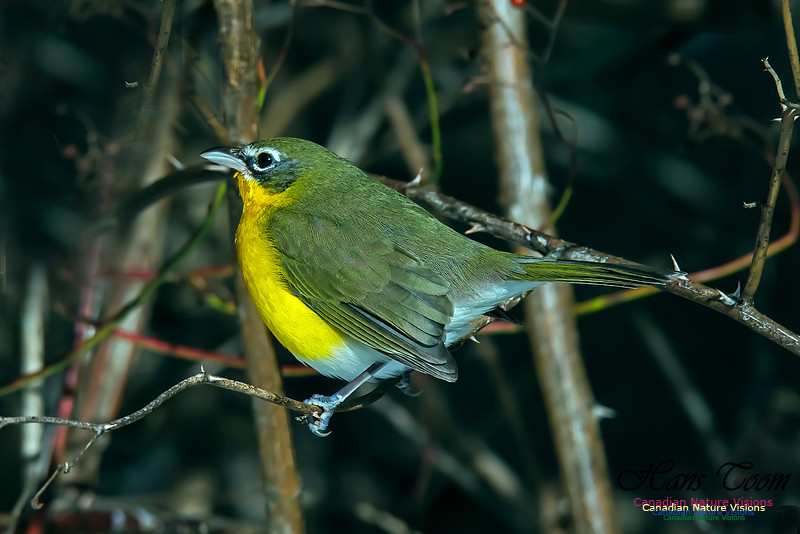
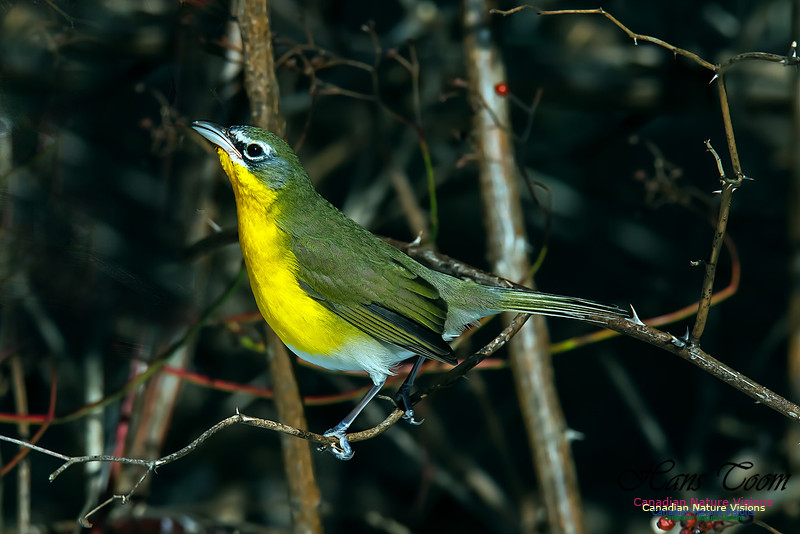
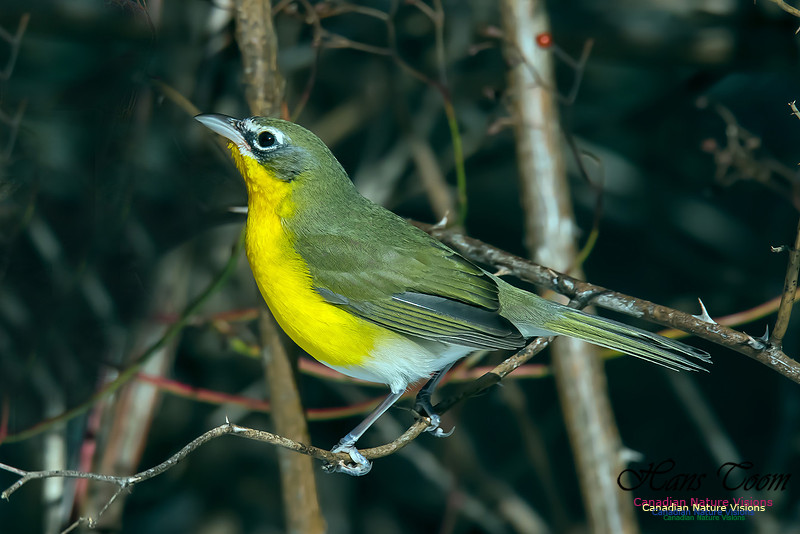
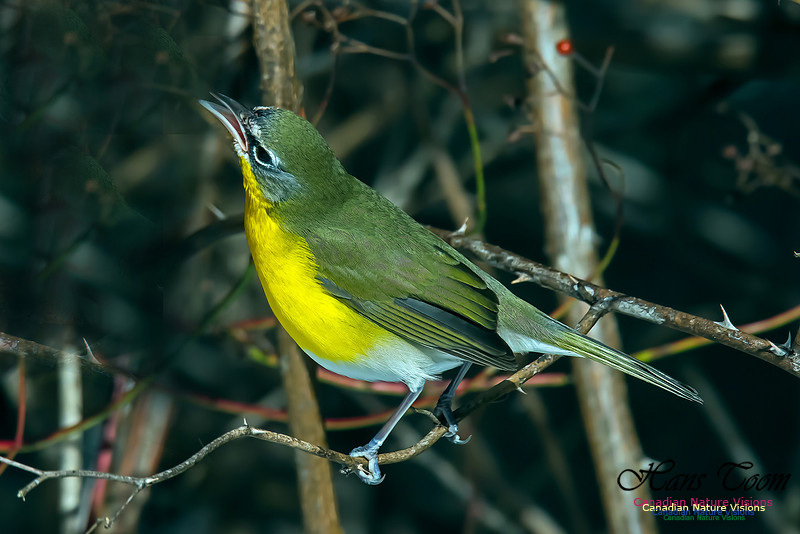
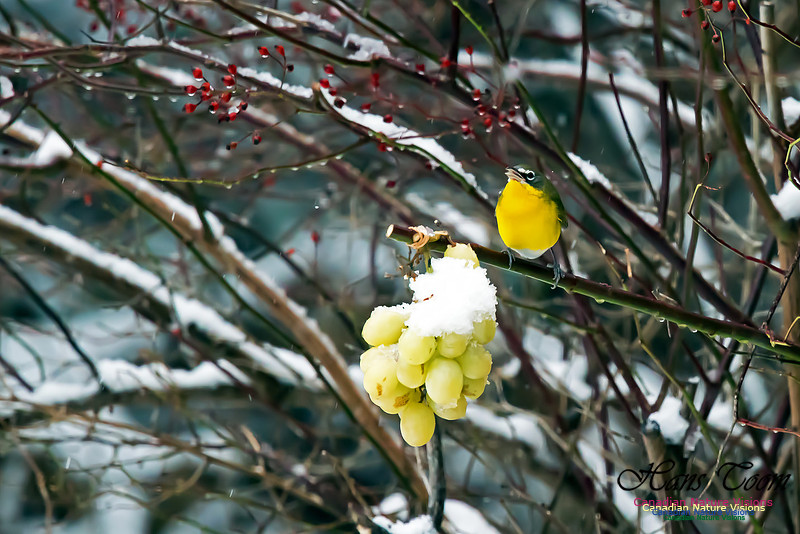
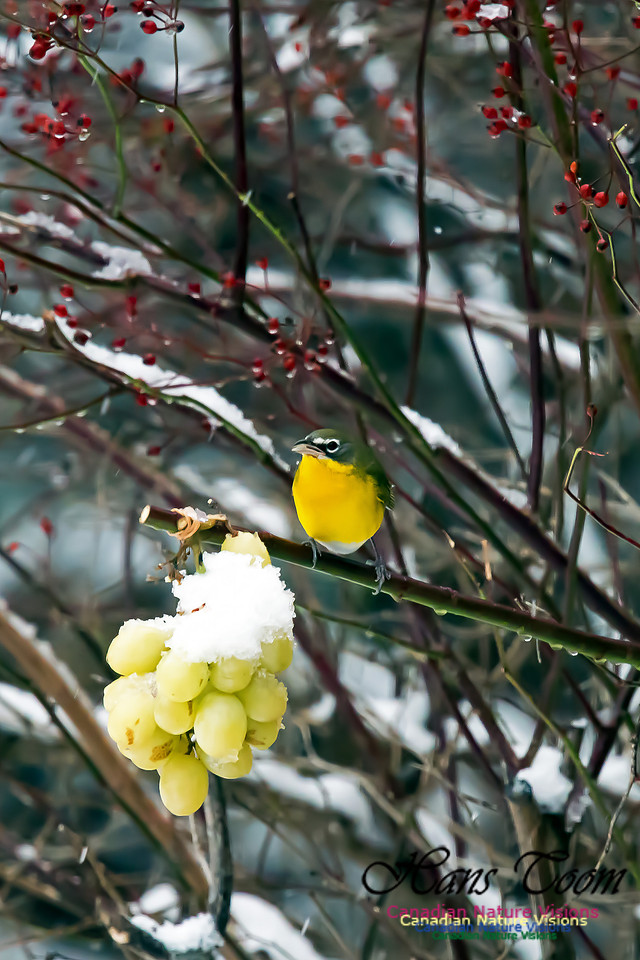
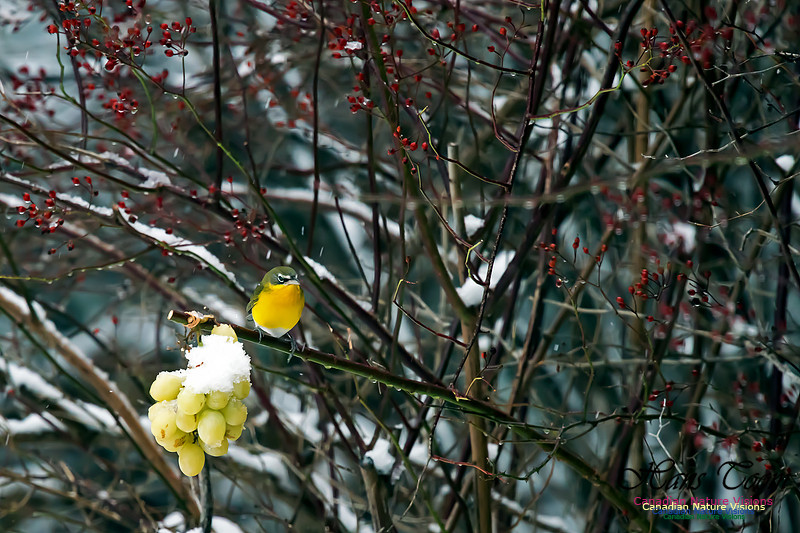
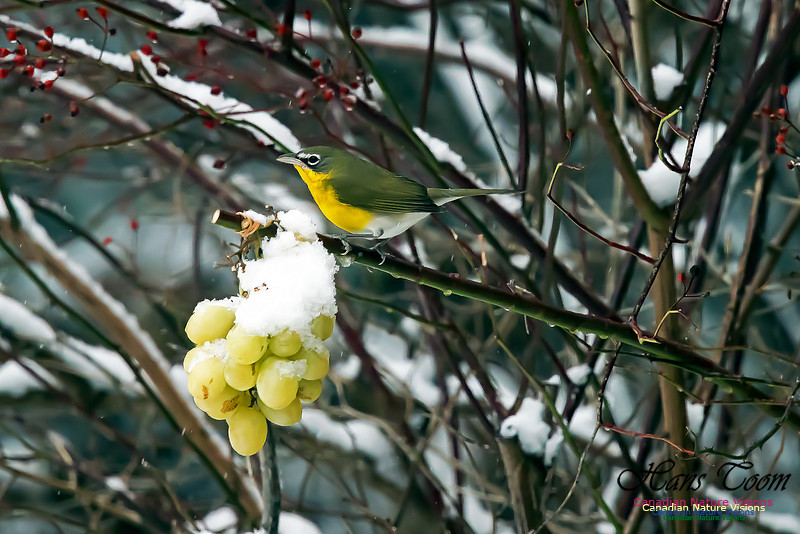
DesignPatiño is a product of cooperation between Koninklijke Marine and Armada Española. The design of the ship is similar to HNLMS Amsterdam of the Royal Netherlands Navy, the vessels were developed in cooperation. Patiño was mostly a civilian design. The vessel is 170 metres (560 ft) and measures 17,045 tons but displaces 7,780 tons. The oiler has a crew of 148 plus 20 extra berths. February 2016 Edition of The BridgeHere is the February, 2016, edition of The Bridge. This newsletter highlights the good work of the Five Bridges Wilderness Heritage Trust over the last year. Highlight and open: http://www.hanstoom.com/bridge-2016-01.pdf I have been involved with the Five Bridges Wilderness Heritage Trust for 14 years. The remarkable work of Beth McGee and others has produced wonderful results such as the protection of Jerry Lawrence Provincial Park and the establishment of the Five Bridges Lakes Wilderness protected area and work to enhance and protect the wilderness and heritage trails on the Chebucto Peninsula. I was extraordinarily lucky in photographing this Canada Warbler pulling a worm last June in Jerry Lawrence Provincial Park, Nova Scotia. Canada Warbler Saving our ChatOur Yellow-breasted Chat remains alert, active and eats vigorously several times per day. It remains alive only because of our help. I provide it red grapes, its favourite food by far, suet, grape jelly and peanut butter. The key to its survival is the first visit to the feeder in the morning, usually about one half hour before sunrise. But here's the problem! A cold bird that has burned off all its energy reserves keeping warm during the night has little left to peck at frozen grapes and even worse for it is to ingest frozen food into an already very cold bird.
I have two options to deal with the cold food in the morning. The first is to bring it in at night and then return it in the morning an hour before sunrise. Needless to say this option is not attractive. So I opted to heat the food so the grapes and other eatables are warm and soft. I place a pair of 250 watt flood lights within a foot of the food. The chat just loves this arrangement and will often remain at the grapes just feeling the warm air welling up under its belly and not eating at all. Grapes at $14 a package and running two 250 lights is not cheap but what is a guy to do?
Our Yellow-breasted Chat will survive this winter barring predation or accident as many others have previously done over the ions. Nova Scotia bird records cannot confirm such an event has happened but these records are short lived and cover only a tiny fraction of the territory in play. My signpost will be the flowering of the Coltsfoot. When this yellow flower emerges from the earth I will say with confidence that the chat has made it through the winter whether or not we see it again. Typically the Coltsfoot blooms out this way in early to mid March. In a terrible winter like last year it bloomed in early April.
Yellow-breasted chat at the kitchen table with offerings of red grapes, suet, grape jelly and peanut butter, a messy presentation for sure, but I doubt the chat cares
The lights at night warming the kitchen table offerings in preparation for the morning
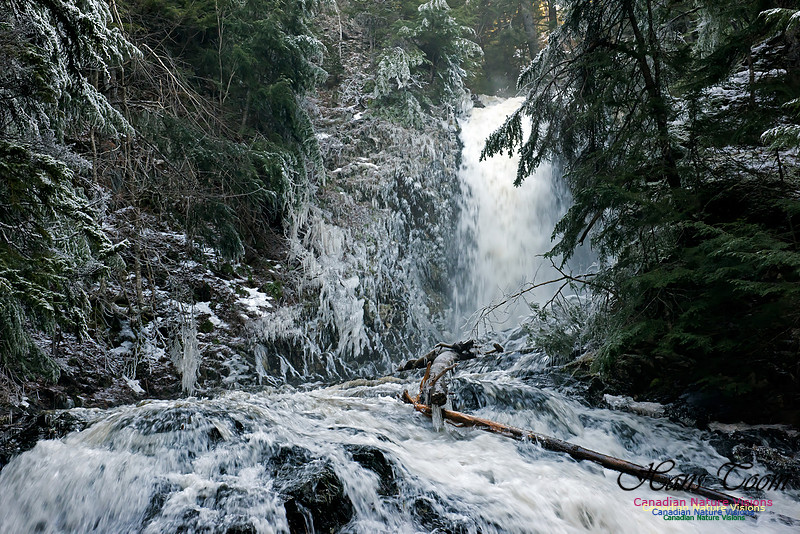
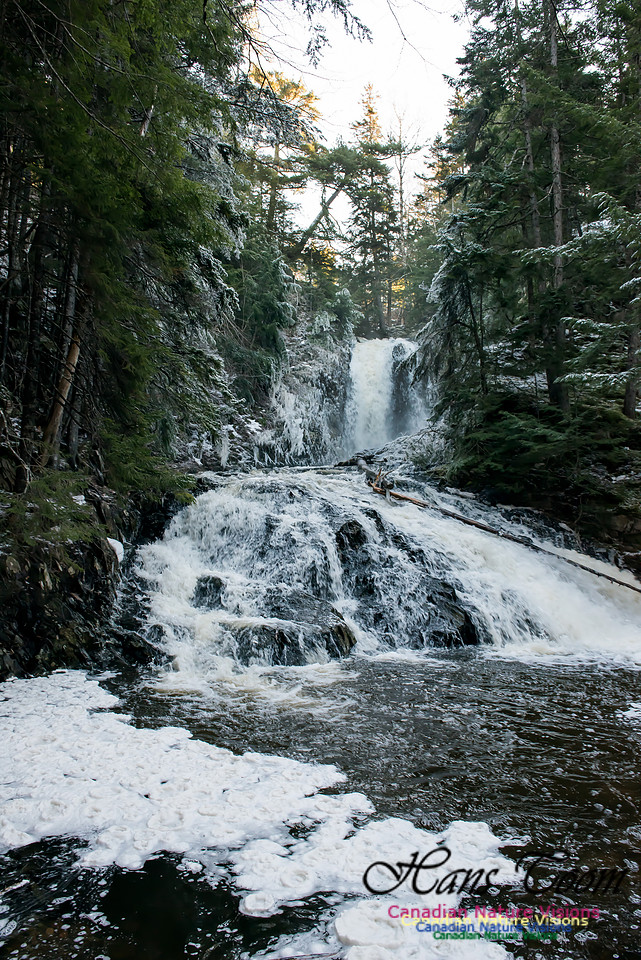
Butcher's Falls and Scottish LonghornI took advantage of this fine day for a quick tour of the Musquodoboit Valley and Butcher's Falls. I donned my cleats to walk down the icy path to the falls. The water is running high and I was ill prepared for the cold so my visit was short lived. Butcher's Falls
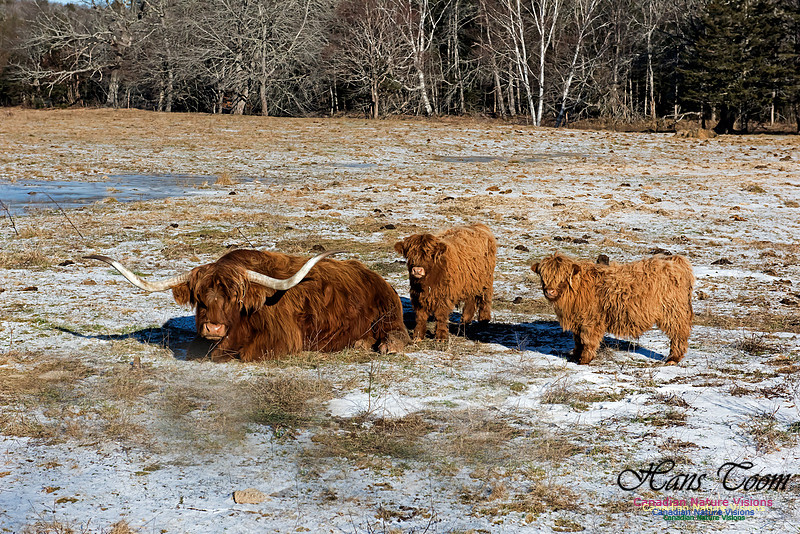
The highlight of the loop was a family of Scottish Longhorns. This elegant bovine always impresses me. Scottish Longhorn
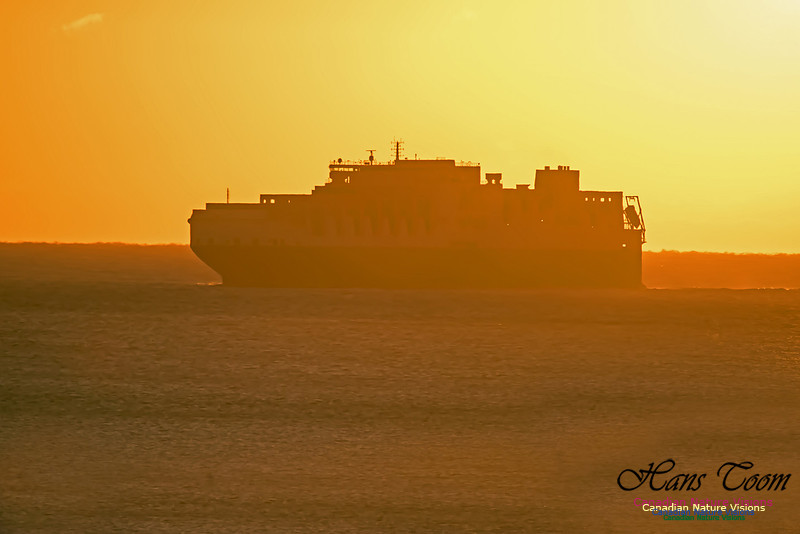
Atlantic StarI photographed the Atlantic Star at sunrise from our living room window just as it was passing Shoal Point(Chebucto Head Light) on its way into Halifax harbour. The Atlantic Star is the largest ship of its type in the world carrying both containers(3800) and vehicles(1300). The mixed cargo allows it to moderate vagaries of the market.
Sanford and Son, Wood DucksLaura and I met the Wood Ducks today, Sanford and Son, at The Dingle, Sir Sanford Fleming Park. I can no longer distinguish between the elder and the son. Despite their smaller size the Wood Ducks are the boss birds of the flock. Always bring seed to scatter amongst the flock. They will appreciate the help.
The Boss Bird
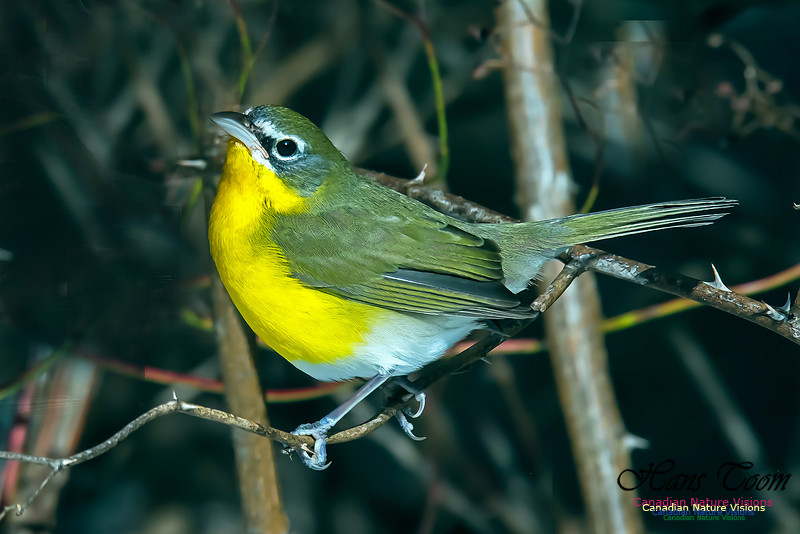
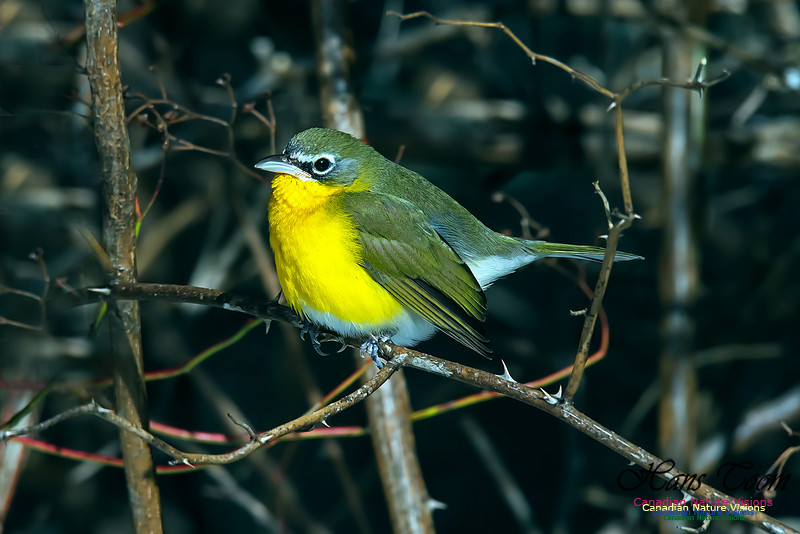
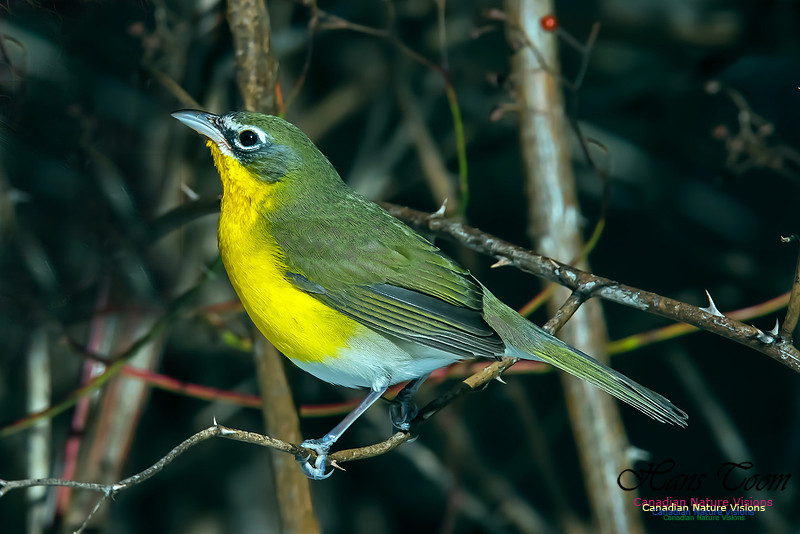
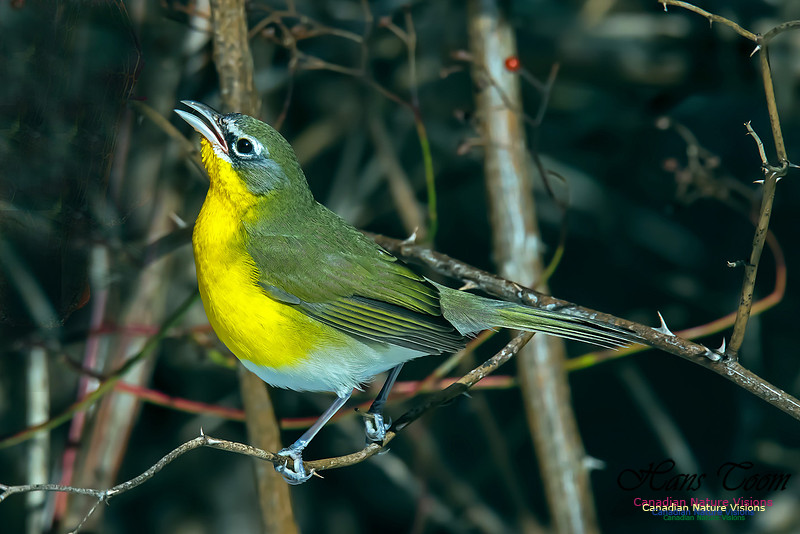
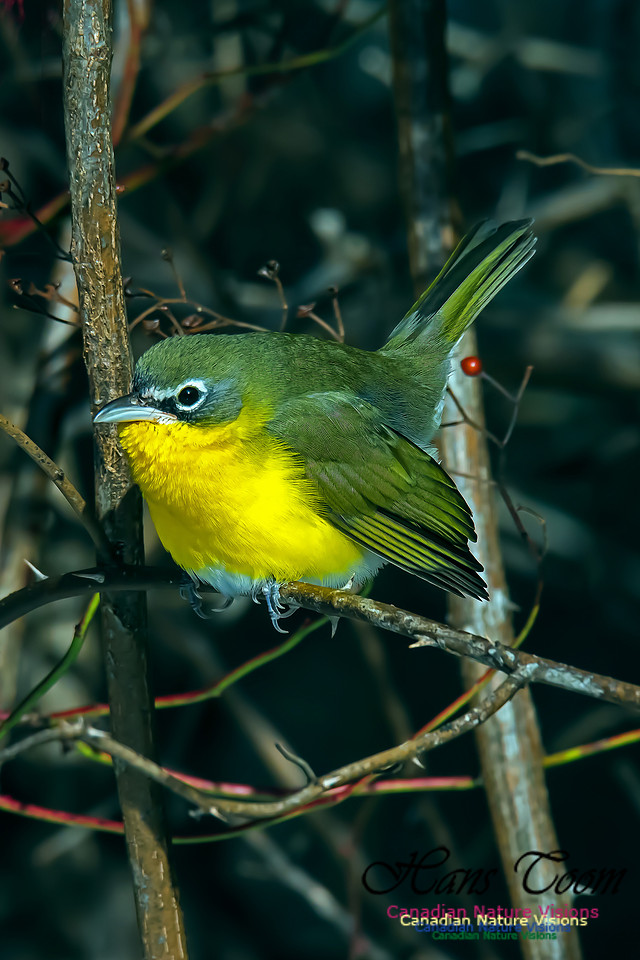
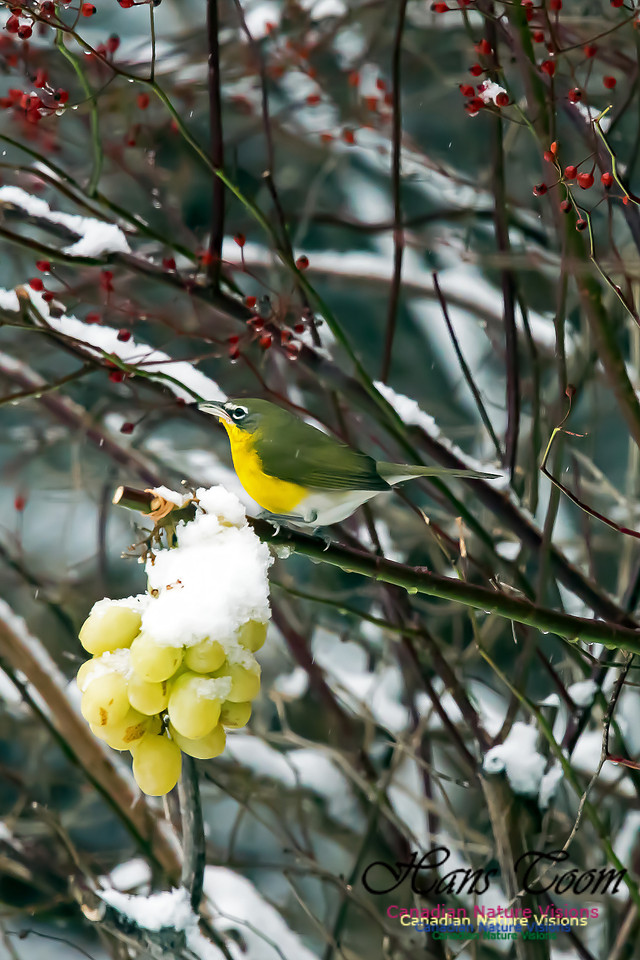
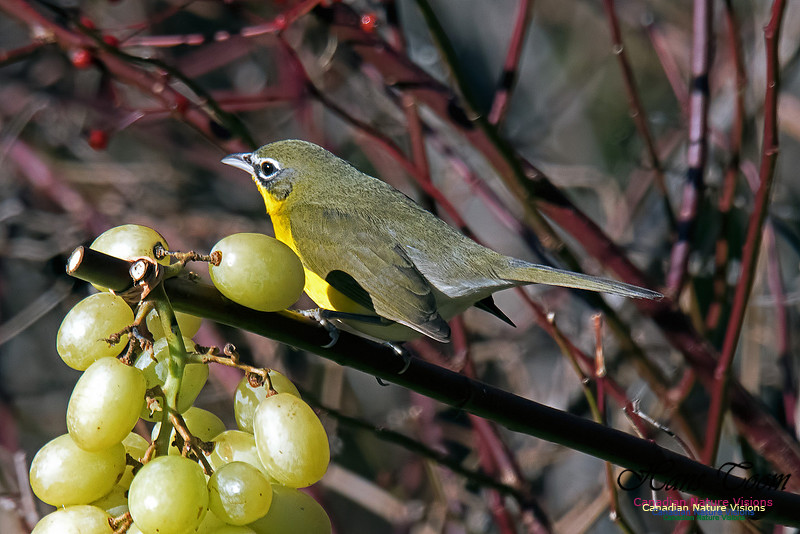
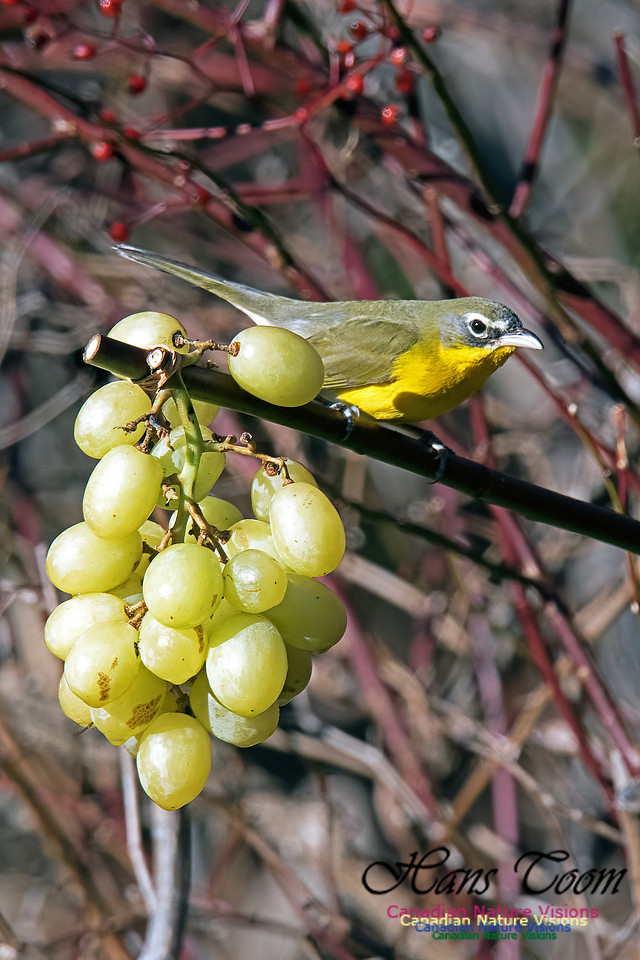
Yellow-breasted Chat in 2016Our Yellow-breasted Chat remains healthy and alert. It feeds several times a day and there is no doubt now that it will make its last stand here with us in Portuguese Cove. I placed its food source at the edge of the multiflora bramble to provide it much appreciated cover when the raptors attack. I have provided yellow and purple grapes, suet and crickets. It is an insect and berry feeder so I hope it begins to nibble on the suet which it appears to be doing. No Yellow-breasted Chat is confirmed as surviving our winter according to, All the Birds of Nova Scotia by Ian McLaren, so I'm hoping this one will be the first. I think it may be roosting somewhere underneath our back deck which will provide it protection against wind, freezing rain and snow. If I knew exactly where it was roosting I might even put out an infrared light to provide it warmth. Yellow-breasted Chat
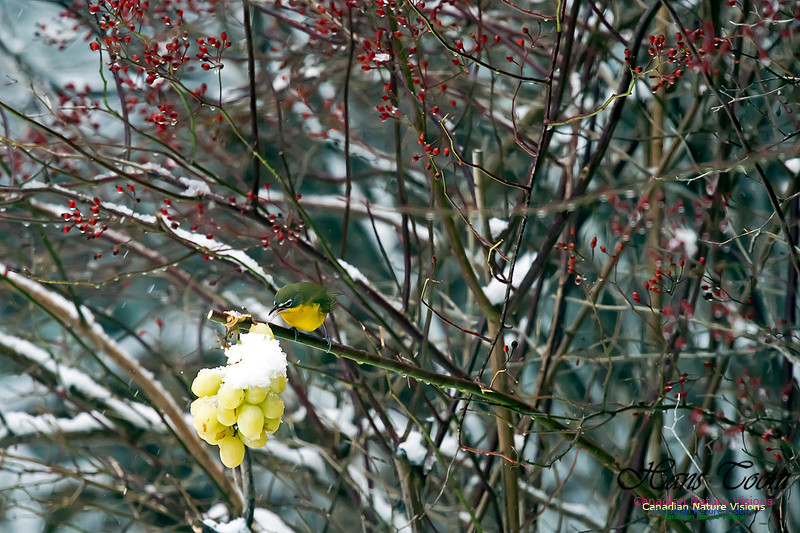
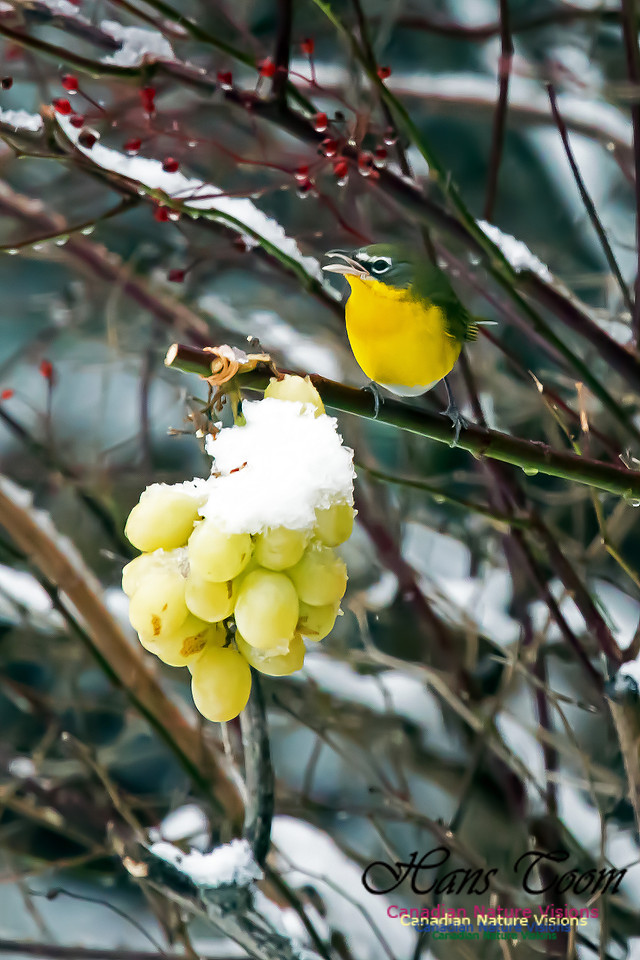
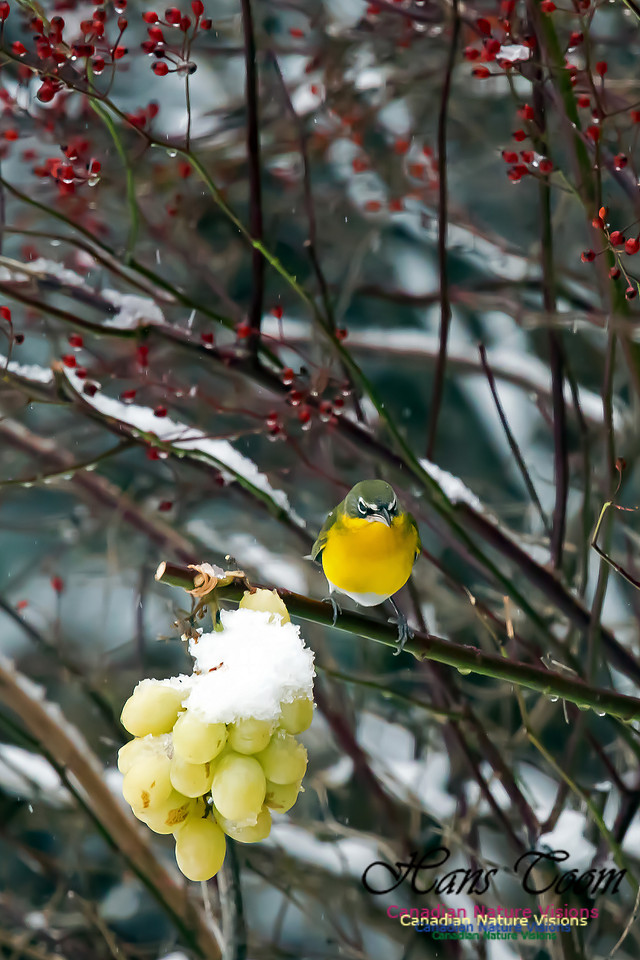
Yellow-breasted Chat in its First SnowfallOur Yellow-breasted Chat took its first snowfall in stride. The bird is active, alert, stealthy and beautiful. No distant photo can do it justice. All my photos presented here are crops. The enlargement of the photos causes the buttery look, not unattractive but slightly unrealistic. Perhaps some day I can get a full frame but I'm pleased with what I have to date.
Christmas Day Full Moon, First One in Thirty Eight YearsLaura and I arrived home about 7PM on Christmas Day and the sky was partially overcast. I hoped for a small break in the passing clouds for a clear record of this experience. Clear skies never came but it was close with a thin veiled mist that briefly allowed for some half decent photos. Interestingly the cycle for Halley's Comet is 76 years so this Christmas full moon event occurs almost exactly half of the circuit time of Halley's comet, if long term averages prevail. I've posted several iterations of this event in an attempt to maximize lunar detail in the photographs but I have very little experience in editing images of this type. Christmas Day Full Moon, December 25, 2015, Portuguese Cove, Nova Scotia
Christmas Day Yellow-breasted Chat, December 25, 2015Our Yellow-breasted Chat was on station all of Christmas Day, eating multflora berries, grapes and yes even a chunk of suet. Suet is essential to its survival plus a hoped for mild winter. If it survives the upcoming storm I'll order some meal worms or get some fishing worms. We were away from home most of Boxing Day so its presence cannot be confirmed for today. Yellow-breasted Chat
Yellow-breasted ChatThe Yellow-breasted Chat that arrived yesterday at our place in Portuguese Cove to celebrate the winter solstice with us is still here, although extremely skittish. The supply of multiflora berries is uncommonly plentiful this year so there is lots to eat. The chat was sharing the brambles with a small flock of Purple Finches and Goldfinches, as well as the usual Song and White-throated Sparrows. The chat was difficult to photograph in the gloom of the day. I salvaged two photographs as it fed on a bunch of red grapes I put out for it. By the time it was more cooperative I was shooting at 850mm, 1/60 second, ISO 6400 and through a window. The combination of gloom, low shutter speeds and high ISO made all of the later photographs unsalvageable. Perhaps it will still be here tomorrow under more manageable lighting. Yellow-breasted Chat
Winter Solstice Sunrise Behind Duncan Reef December 21, 2015I went to Duncan Reef during the darkness of the predawn morning to photograph the winter solstice sunrise at Duncan Reef. The winter solstice is shared this year between December 21 and December 22 so I will try again tomorrow at Crystal Crescent Beach Provincial Park. A troop of Purple Sandpipers flew back and forth to celebrate the event with me. At home in Portuguese Cove a Yellow-breasted Chat added to the festivities. Macho Picchu is one one of the most celebrated sites of Inca culture. Visiting this place is on my bucket list. Courtesty of Wikepedia Inti Watana stoneMain article: Inti Watana, Urubamba

Inti Watana is believed to have been designed as an astronomic clock or calendar by the Incas

The Inti Watana stone is one of many ritual stones in South America. These stones are arranged to point directly at the sun during the winter solstice. The name of the stone (perhaps coined by Bingham) derives from Quechua language: inti means "sun", and wata-, "to tie, hitch (up)". The suffix -na derives nouns for tools or places. Hence inti watana is literally an instrument or place to "tie up the sun", often expressed in English as "The Hitching Post of the Sun". The Inca believed the stone held the sun in its place along its annual path in the sky. The stone is situated at 13°9'48" S. At midday on 11 November and 30 January, the sun stands almost exactly above the pillar, casting no shadow. On 21 June, the stone casts the longest shadow on its southern side, and on 21 December a much shorter shadow on its northern side. Winter Solstice Sunrise December 21, 2015, Duncan Reef, Nova Scotia A large black cloud leading today's depression rolled in just as I was taking the photos.
|
|||||||||||||||||||||||||||||||||||||||||||||||||||||||