White Fringed Orchid ExpeditionI went on my first White Fringed Orchid trip yesterday. It's still early but I did find a few blooming. I was also hoping to find the Tall Bog Orchid a less common species. I only found one last year. I will return in a week or two to see how they are progressing. August is the best month for wildflowers in Nova Scotia probably due to the presence of pollinators. This is definitely a chicken and egg problem or is it another unexplained miracle of nature? As I wandered yesterday looking for orchids I found lots of other wildflowers some of which I photographed. Every orchid and wildflower has several local folk names, all valid, just like folk names for birds. Brown-eyed Susan
Daisy
Daisy Fleabane
Evening Primrose
Rabbit's Foot Clover
Hop Clover
Mullein
Purple Loosestrife
Purple Vetch
Queen Anne's Lace
Rabbit's Foot Clover
St. John's Wort
Tall Sweet Clover
White Fringed Orchid
Wild Rose and Red Clover
Yarrow
Swamp SparrowThe Swamp Sparrow is a denizen of marshes and wet places. It has a jaunty cinnamon coloured cap with a white centre stripe and sings a trill which often falls off at the end. The brown shoulder patch is a good field mark as well as its colourful white and cinnamon beret. It arrives early and leaves late nesting in most of Canada west to the Rocky Mountains. Swamp Sparrow
Snow GooseSnow Geese occasionally stray into Nova Scotia on their migration north or south. They are central flyway birds seen in the hundreds of thousands at Oak Hammock Marsh north of Winnipeg. They forage in the fields surrounding the marsh or pass overhead in massive flocks. Lipstick is their trademark. They are another all-Canadian goose breeding in the tundra and arctic of Canada's north lands. Snow Goose
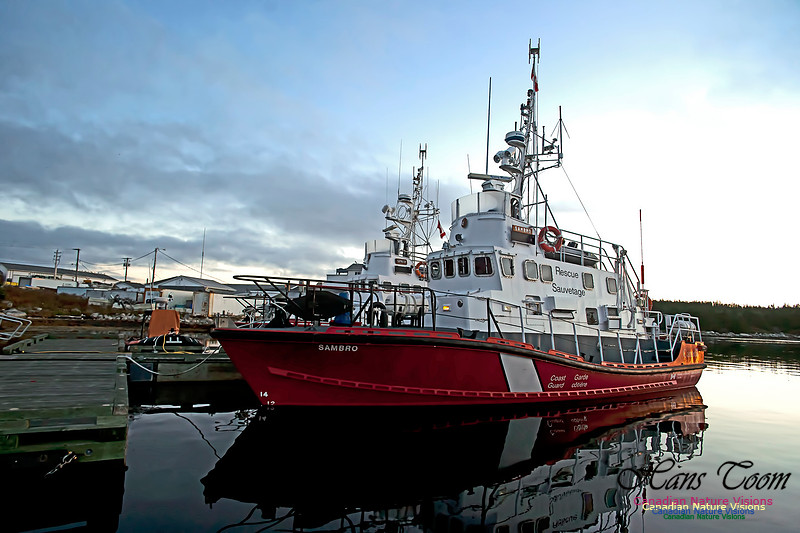
Canadian Coast Guard ShipsThis is a collection of photos of Canadian Coast Guard ships. Most were photographed from Shoal Point or from our kitchen window. Canadian Coast Guard Ships
Semipalmated SandpiperThe Semipalmated Sandpiper is our most common and widespread sandpiper in July and August. It congregates in world record numbers in the Minas Basin in mid August. It stops here to fuel up before its final flight leg south. It will also hop about on the coastal rocks to feed on the critters trapped in the small tidal pools between the rocks. Semipalmated Sandpiper
Comet NeowiseThis is the story of the Great Comet Neowise expedition, a five minute drive to Shoal Point (Chebucto Head Light) from our home in Portuguese Cove. The last time I tried for a comet was Halley's Comet. We saw one later in Winnipeg but I wasn't into photography yet. I went all the way to Barbados to enjoy Halley's Comet but the spectacle was a bust. It turned out to be just a fuzzy ball with no visible tail. Comet Neowise has a tail but it took a while for us to find it. Thank goodness we knew it was located below the Big Dipper. I was hoping to capture the International Space Station as it passed under the comet at 10:20PM ADT but alas by the time I got organized all I captured was the end of the pass. I couldn't get the camera to fire until I figured out that I had to switch the lens to manual focus. The poor camera was trying to autofocus in a black sky without success of course. I did have the camera on manual focus though so I got that part right. The first photo was taken at 200mm full frame for a 20 second exposure. The other photos were taken at at 16mm and 35mm also at 20 second exposures. The halo of light created by the City of Halifax was a distraction. Next time I will be better organized. Comet Neowise This is an unsaturated 200mm image highlighted to show the tail.
This is a saturated image(in colour) but also highlighted to show the tail.
This is the image without highlights.
The rest of the photos are taken at 16mm and 35mm for a much wider field.
Note the International Space Station on the right of the frame. It was supposed to be under the comet. Double drat!!
Before Neowise appeared there was the sunset and the after gleaming to enjoy.
Wilson's SnipeThe Wilson's Snipe is heard more often than seen. When disturbed it takes off with its characteristic winnowing sound caused by air rushing through its flight feathers. It is a common denizen of our marshlands and when seen its usually probing the mud for wriggling goodies to eat. Wilson's Snipe
North American MinkThe North American Mink is widespread and common but shy so it is hard to find and harder to photograph due to lack of contrast on its fur coat. Its an adept swimmer and has a varied diet of smaller mammals, birds and aquatic life. American Mink
Varied ThrushI was not successful in photographing this elegant thrush well. It's odd because I used good equipment but severe cropping and back lighting can take a heavy toll. The Varied Thrush has a haunting whistle often sung from the deep rain forests of the west coast of British Columbia. My most memorable experience with this thrush was at Pacific Rim National Park(my favourite national park) as it sang a duet with the Winter Wren while the morning dew was dripping off the foliage. It is mega rare in Nova Scotia. Varied Thrush
American CootThis unassuming little swimmer breeds locally in Nova Scotia especially in the large marshes near the New Brunswick border. It's not a shy bird and is easy to photograph if you can find one locally. American Coot
Rain Drops on Showy Lady's Slipper Orchid and Canada LilyThe Showy Lady's Slipper Orchid is finished for the season but I managed a few photographs just after a shower. I also checked out the Canada Lily again and although its very early there were a few flower heads open. The rain drops on both wildflowers always add a nice touch. Rain Drops on Showy Lady's Slipper Orchid and Canada Lily
Grey HeronThe Grey Heron, a Eurasian wader, is a mega rare bird for Nova Scotia. This one from Miner's Marsh is Nova Scotia's first confirmed record. There was a report from 2001 but it was not confirmed. Moribund or dead birds have been found on ships heading west. As usual the caveat applies that reported birds are seldom the first to visit since many are unseen or are seen but not reported. The Grey Heron flew up into a tree where I first saw it. It didn't leave the tree or do much of anything but preen. I tried photos from other angles but the backlight all but ruined the effort. The name is misspelled in most North American literature thanks to the American Birding Association who think they have the right to stamp any name they like on a bird, even a European bird . "Grey" is the European spelling which is most certainly the correct spelling since its their bird to name. The Canadian and British spelling for a shade of colour is also "grey", whereas in the United States the spelling is "gray". Folk names such as Grey Heron or Gray Heron are neither right or wrong. Any local name is as good as any other. The only correct name is the scientific name. Grey Heron
Peggy's Cove SunsetMany of my photographs drop down on the right side and I have to crop to get them level. To my amazement this even happens when I use a tripod like with these Peggy's Cove sunset photographs. I wonder if its something to do with being right handed or am I using too much of the left or logical side of my brain which controls movement on the right. Perhaps I need to work on my artistic skills, the right side of my brain. Thinking about this hurts:) Sunsets are tricky because one needs the right mix of puffy cumulus or cumulonimbus clouds to bring out the colour above the horizon. I've usually had good luck with these conditions with sunrises when the fog is not around.
Canada LilyI visited the dying embers of the Showy Lady's Slipper Orchid and then checked out the native Canada Lily. The Canada Lily is just starting to bloom and should be in full flower in a week or two. Showy Lady's Slipper Orchid
Yellow Lady's Slipper OrchidI visited the home of the Yellow Lady's Slipper Orchid and Ram's Head Orchid twice this spring. I had no luck with the Ram's Head Orchid which is probably more about my reluctance to search in the hummocks off the trail thanks to the presence of ticks. I did find the Yellow Lady's Slipper Orchid in reduced numbers. The population difference could be due to natural year over year variations in numbers or more likely poaching. Yellow Lady's Slipper Orchid
|